WPC cladding profiles can vary significantly in width, surface geometry, cross-section, and effective coverage. When the panels are installed horizontally, these differences affect not only the finished appearance but also the amount of material required and installation efficiency.
If several profiles are suitable for horizontal installation, choosing between them should not be based on overall width alone. A better approach is to compare the installed appearance, effective coverage, profile structure, and fixing characteristics.
This guide explains the main factors to consider when comparing WPC cladding profiles for horizontal installation.
Key Takeaways
Start with the installed appearance, including profile width, surface geometry, and spacing of repeated lines.
Compare effective coverage width, not only the overall profile width.
Wider coverage can reduce the linear meters and repeated installation operations required per square meter.
Check the profile cross-section, including its interlocking and fixing structure.
After choosing a profile, confirm that the joist spacing, expansion gap, and fixing materials suit the installation conditions.
Table of Contents
1. Start With the Installed Appearance
For many buyers, appearance is the first factor when choosing a WPC cladding profile.
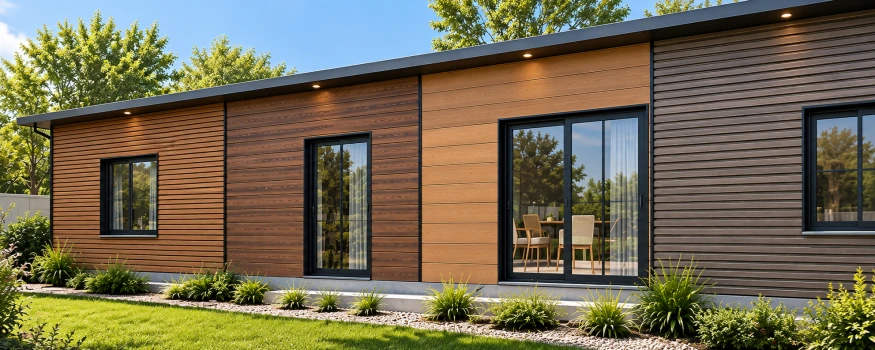
Some prefer narrower profiles with more repeated horizontal lines across the wall. Others prefer wider panels that create broader sections and fewer repeated joints.
Surface geometry also makes a major difference. A flat profile creates a relatively continuous wall surface, while fluted or Great Wall profiles create stronger shadow lines through repeated raised and recessed sections.
When comparing profiles, consider:
overall visual width,
flat or fluted surface,
number and width of grooves,
depth of the profile pattern,
frequency of repeated lines, and
wood-grain appearance.
A small sample can show the surface finish, but it may not clearly show how the pattern will repeat across a complete facade. Installed photos or larger assembled samples are therefore useful when selecting profiles for a wholesale product range.
2. Compare Effective Coverage, Not Just Overall Width
The overall width shown on a profile drawing is not necessarily the actual width added to the finished wall.
Part of a WPC cladding profile normally contains the interlocking and fixing structure. Once adjacent panels are connected, this section does not contribute to the effective wall coverage.
This is why effective coverage width is more useful when comparing different profiles.
For example, a panel may have an overall width of 163 mm but provide only 150 mm of effective coverage after installation.
Effective coverage affects:
linear meters required per square meter,
quantity calculations,
installation workload, and
bulk order planning.
The following examples use four MATECO WPC outdoor cladding profiles and a standard board length of 2.9 m:
| Profile | Overall Size | Effective Width | Coverage per 2.9 m Board | Linear Meters per m² |
|---|---|---|---|---|
| Q155CD | 115 × 16 mm | 100 mm | 0.290 m² | 10.00 m |
| Q14515CD | 145 × 15 mm | 125 mm | 0.3625 m² | 8.00 m |
| Q160CD | 163 × 16 mm | 150 mm | 0.435 m² | 6.67 m |
| Q19020C | 190 × 20 mm | 175 mm | 0.5075 m² | 5.71 m |
The figures above are theoretical coverage values before cutting and installation waste.
These examples show why two profiles should not be compared only by their nominal dimensions.
Q160CD, for example, is MATECO WPC's widest flat outdoor wall cladding profile and provides 150 mm of effective coverage. Q19020C provides 175 mm of coverage but has a narrower Great Wall-style surface pattern.
The choice between them is therefore not simply 150 mm versus 175 mm. The installed appearance is also different.
3. Consider Installation Efficiency
Effective coverage also influences installation efficiency. A profile with greater effective width covers more wall area per linear meter, so fewer linear meters are required for the same wall area.
100 mm effective width requires approximately 10 linear meters per m².
125 mm effective width requires approximately 8 linear meters per m².
150 mm effective width requires approximately 6.67 linear meters per m².
175 mm effective width requires approximately 5.71 linear meters per m².
Fewer linear meters generally mean fewer repeated panel positioning and fixing operations. This is one reason some buyers prefer wider profiles when installation speed is important.
However, greater coverage does not automatically make a profile the better choice. If a narrower profile provides the surface pattern preferred by the local market, appearance may outweigh the difference in installation efficiency.
The two factors should therefore be considered together: appearance + effective coverage.
4. Look at the Profile Cross-Section
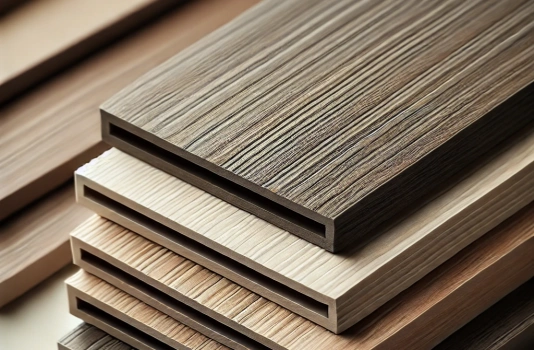
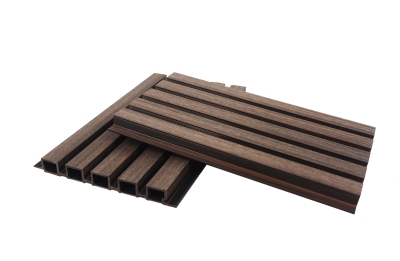
The front surface does not tell you everything about a WPC cladding profile. Two profiles can have similar widths or surface patterns but different cross-sectional designs.
When comparing profiles, check:
overall thickness,
internal chamber structure,
rib arrangement,
interlocking geometry,
fixing edge, and
screw position.
For interlocking WPC cladding, the male-and-female connection is particularly important.
During horizontal installation of MATECO WPC outdoor cladding, the recessed female edge faces downward. The male edge of the next panel then engages with it.
The fixing position is built into the profile so the panel can be secured before the following panel is connected. The male-and-female joint should be engaged according to the profile design rather than leaving an artificial gap between adjacent rows.
This is why examining a cross-sectional drawing is useful when comparing WPC cladding profiles from different suppliers. The front surface may look similar while the connection and fixing structures are different.
5. Consider Fixing Characteristics When Needed
For many markets, appearance and effective coverage will be the main selection factors. However, fixing characteristics can become more important in certain outdoor conditions.
Different profile structures may provide different nail- or screw-holding characteristics. This can be relevant where buyers pay particular attention to fixing security, including areas exposed to stronger winds.
For example, MATECO WPC's Q14515CD has strong nail-holding characteristics in addition to its wood-like surface appearance.
However, the profile itself should not be treated as a complete wind-resistance system. Actual performance also depends on the joist material, joist spacing, fasteners, substrate, fixing method, and installation quality.
Unless a complete cladding assembly has been tested for a specific wind load, nail-holding characteristics should not be converted directly into a wind-speed rating.
6. Check the Horizontal Installation Requirements
After selecting the profile, confirm that it is compatible with the intended installation conditions.
All MATECO WPC outdoor co-extrusion wall cladding profiles can be installed horizontally or vertically. For horizontal installation, the supporting joists run vertically.
MATECO WPC's current installation guidance specifies:
| Temperature | Maximum Joist Spacing |
|---|---|
| ≤ 40°C | 50 cm |
| > 40°C | 35 cm |
Expansion clearance also needs to be understood correctly.
The interlocking male-and-female edges between adjacent rows are engaged normally. The 2–3 mm gap applies where two panel lengths meet end to end, rather than between the interlocking edges of each row.
For exterior installations, galvanized steel joists are generally recommended. Stainless steel screws are recommended in coastal environments.
If the existing wall is sufficiently flat and provides a suitable substrate for reliable fixing, direct installation may also be possible. In most cases, however, using joists makes alignment and fixing easier.
WPC Cladding Profile Selection Checklist
Before choosing a profile for a wholesale or distribution range, compare:
Appearance: flat, fluted, wide, narrow, and groove pattern.
Overall size: physical profile dimensions.
Effective width: actual installed coverage.
Coverage efficiency: linear meters required per square meter.
Cross-section: chambers, ribs, and interlocking structure.
Fixing characteristics: fixing edge and fastener position.
Installation compatibility: joist spacing, gaps, and fixing materials.
Commercial specifications: colors, lengths, trims, MOQ, and packing.
The objective is not necessarily to carry as many profiles as possible. Profiles with clear differences in appearance and coverage can provide buyers with more meaningful choices while reducing unnecessary SKU overlap.
Frequently Asked Questions
Can WPC cladding be installed horizontally?
Yes. WPC cladding can be installed horizontally when the profile and fixing system support this orientation. All MATECO outdoor co-extrusion wall cladding profiles support both horizontal and vertical installation.
Is a wider WPC cladding profile better for horizontal installation?
Not necessarily. Wider effective coverage can reduce the linear meters and repeated installation operations required per square meter, but narrower profiles create different proportions and surface patterns.
Choose according to both the desired appearance and coverage efficiency.
What is the difference between overall width and effective coverage width?
Overall width is the physical width of the complete profile. Effective coverage width is the amount of wall width added after adjacent panels are interlocked.
Because part of the profile is used for interlocking and fixing, effective width is normally smaller than overall width.
Do horizontal WPC cladding panels need an expansion gap?
Where two panel lengths meet end to end, MATECO recommends a 2–3 mm gap.
This does not mean a 2–3 mm gap should be left between the male-and-female interlocking edges of adjacent rows.
Can WPC cladding be installed directly on a wall?
Yes, if the wall is sufficiently flat and suitable for reliable screw fixing.
For many exterior installations, however, a joist system makes it easier to level, position, and fix the panels.
Final Thoughts
Choosing a WPC cladding profile for horizontal installation is mainly about balancing appearance, effective coverage, profile structure, and installation efficiency.
Start with the wall appearance you want. Then compare the effective coverage rather than relying only on nominal profile width. After that, examine the cross-section and fixing structure before checking the installation requirements.
For distributors and importers, this approach also makes it easier to build a focused product range: different profiles should provide meaningful differences in appearance or coverage rather than simply adding more similar SKUs.
MATECO WPC supplies multiple outdoor co-extrusion WPC cladding profiles for wholesale and bulk orders. Contact us for profile drawings, color options, MOQ, packing information, and quotations.