Decking Material Options for Contractors & Distributors: 2026 ROI & Performance Guide
Why Deck Material Selection Is Now a Business Decision
Choosing a decking line is no longer just about aesthetics. For professionals, the material on the truck directly impacts the bottom line. In an era of fluctuating timber prices and labor shortages, your choice determines:
Installation Speed: Can a 2-man crew finish in 2 days or 4? Warranty Risk: Will you be back in 18 months to fix warping boards? Supply Chain Stability: Is the price locked in, or does it change weekly?
Comparison Matrix: Decking Materials at a Glance
| Material Category | Initial Cost | Installation Speed | Maintenance | Service Life | B2B Risk Level |
| Pressure-Treated Wood | Low | Fast | High | 5–10 yrs | High (Callbacks) |
| Exotic Hardwood | Very High | Slow | Medium | 20+ yrs | Medium (Sourcing) |
| Standard PE Composite | Medium | Fast | Low | 10–15 yrs | Medium (Cracking) |
| Co-Extruded WPC | Medium | Fast | Minimal | 25+ yrs | Low (Stable) |
Deep Dive: Evaluating Core Material Categories
1. Pressure-Treated (PT) Softwood
The Trade-off: Low upfront cost vs. high "hidden" costs. The Risk: Post-installation checking, splitting, and chemical leaching often lead to client dissatisfaction within the first 24 months.
2. Exotic Hardwoods (Ipe, Cumaru)
Labor Intensive: Requires pre-drilling and specialized saw blades, ballooning labor costs. Sustainability Hurdles: Increasingly difficult to source with FSC certification, which is now a requirement for many commercial tenders.
3. Wood-Plastic Composite (WPC) – The Professional’s "Sweet Spot"
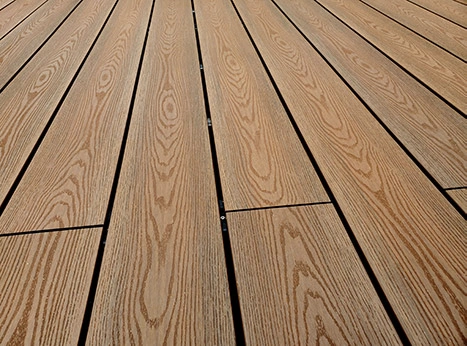
Engineering Advantage: Uses a 360-degree protective "cap" that shields the organic core from moisture and UV. B2B Benefit: It offers the look of hardwood with the consistency of a manufactured product. No knots, no defects, 100% yield per pallet. Explore Options: View High-Performance WPC Profiles & Technical Specs
3 Technical Pillars That Drive Profitability
A. The Filler Ratio (The "Durability Index")
Cheap Composites: High filler content makes the board brittle and prone to "edge-crumbling" during installation. Premium WPC: Optimized polymer-to-fiber ratios ensure the board can handle structural spans and fastener torque without cracking.
B. Co-Extrusion vs. Mono-Extrusion
Co-extrusion bonds the outer shield to the core under high heat without glues. Result: Zero delamination and superior scratch resistance in high-traffic commercial areas like hotels or public boardwalks.
C. Weight-to-Strength Ratio
Lower shipping costs per container. Reduced worker fatigue and faster on-site handling. Lower dead-load on sub-structures.
The 10-Year Lifecycle Cost Analysis (TCO)
Year 0: Wood is 30% cheaper than WPC. Year 3: Wood requires sanding and staining ($2.50/sq ft labor + materials). Year 7: Wood requires board replacements. WPC only requires a power wash. Year 10: WPC has officially become 40% cheaper than wood in total aggregate spend.
Climate-Specific Selection Guide
High-UV Zones (Middle East/Australia): Prioritize Color Fastness Ratings. Look for UV-inhibitors in the cap stock. High-Moisture/Coastal Zones: WPC is non-porous. Unlike wood, it will not rot or host mold in humid environments. Extreme Temp Variation: Ensure your WPC has a low Coefficient of Thermal Expansion to prevent "buckling" at the joints.
Why Partnering with the Right Manufacturer Matters
Bulk Consistency: Does the color of the first pallet match the 50th? Lead Time Reliability: Can they meet the "Groundbreaking" dates of your commercial projects? Technical Support: Do they provide CAD drawings, fire ratings (Class B), and slip-resistance certifications (R10/R11)?